
Dr. Darryl S. Adams, Ed.D.
He has always used the microphone to help people.
First on MTV, with the first African-American rock band the network ever played. Then for thirty years in a school district, ending at the White House. Now on artificial intelligence.
Same instrument. Same job. The stage just kept changing.
My perspective on AI is grounded in decades of educational leadership, public accountability, and responsibility for the people affected by technology decisions.
One path. Seven stages.
Music Educator
Where the instrument came first — before the classroom, the district, or the boardroom.
School Principal
Site leadership — the first room where a decision carried real consequences.
Superintendent
Coachella Valley Unified. $40M+ in grants. WiFi-on-Wheels.
National Leadership
Top 100 Most Innovative Superintendents. Recognized at the White House.
Google GSV Executive Coach
Executive coaching through the Google GSV program.
Human-Directed AI™
People lead. Technology serves. Leadership decides.
Dr. Adams Global™
The practice built on everything above it.
It started on MTV.
In 1984 I was the keyboardist, synth player, and co-writer for Xavion — a six-piece rock band out of Memphis, signed to Elektra Records, managed by Tommy Mottola. I performed under my legal name, Derwin Adams. Too many people could not pronounce it, which turned out to be a preview of the next forty years.
Our album Burnin’ Hot was recorded at Ardent Studios in Memphis. The single, “Eat Your Heart Out,” went into rotation on MTV.
Xavion was the first African-American rock band to appear on MTV. Four years before Living Colour. Critics compared us to Prince and Run-DMC. We toured with Hall & Oates, Sly & the Family Stone, and the Bar-Kays.
I was in my twenties. And a reporter asked me what the band was actually for.
I told him musicians have enormous power to reach large numbers of people — and they should use it to help people, not hinder them.
I said our music was about staying fit, staying positive, going to school, and loving your family.
I was twenty-something years old, on a national tour, in a rock band, telling a magazine that music should tell kids to stay in school.
And then I went and ran the schools.
You do not have to take my word for it.
Xavion — “Eat Your Heart Out” (Elektra, 1984). Keyboards and synth: Derwin Adams.
When a district books me to close a staff day with a live performance, this is the man they are booking. It is not a hobby I picked up late. It is the thing I did first.
I put the internet on a school bus.
I became superintendent of Coachella Valley Unified School District — one of the poorest districts in America. Our students lived in trailer parks and farmworker housing. Many had no internet at home. Some had no electricity.
So we did the obvious things first. I secured more than $40 million in grants. We passed a technology bond. We put a device in the hands of every single student and teacher in the district.
And then the children took the devices home to houses with no internet, and the devices did nothing.
So we took WiFi routers, mounted them on school buses, and parked the buses in the neighborhoods overnight.
Children sat on the steps of their homes and did their homework off a bus.
We called it WiFi-on-Wheels.
The U.S. Department of Education named me one of the Top 100 Most Innovative Superintendents in the nation and invited me to the White House to sign the Future Ready pledge.
President Obama recognized the work personally. Not the technology. What the technology was for.
In 1984 I stood on a stage and told children to stay in school.
Thirty years later I was parking buses outside their houses so they could finish their homework.
The White House, 2014. Future Ready pledge signing, U.S. Department of Education Office of Educational Technology.
One job. Four rooms.
Xavion. Elektra Records. MTV. A rock band from Memphis telling kids to stay in school, on a national tour, in front of arenas.
I stopped telling kids to go to school and went to work in one. Teacher. Site administrator. Every level of a system I had only ever sung about.
Thirty years in public education, ending as Superintendent of Coachella Valley Unified — one of the poorest districts in America. Secured more than $40 million in grants. Put a device in the hands of every student and teacher. Then put WiFi on the school buses so the devices would actually work. Named among America’s Top 100 Most Innovative Superintendents by the U.S. Department of Education, and recognized at the White House by President Obama.
Artificial intelligence arrived in our institutions before the policy did. Someone has to stand up and answer for it. I have spent my whole life preparing for a room I did not know was coming.
Leadership experience. Human accountability.
As a former superintendent, I understand the responsibility of explaining technology decisions to boards, staff, families, and communities.
That experience shapes my approach to Human-Directed AI™: establish clear decision rights, examine the evidence, and keep people accountable for consequential outcomes.
People lead. Technology serves. Leadership decides.
What is actually behind this.
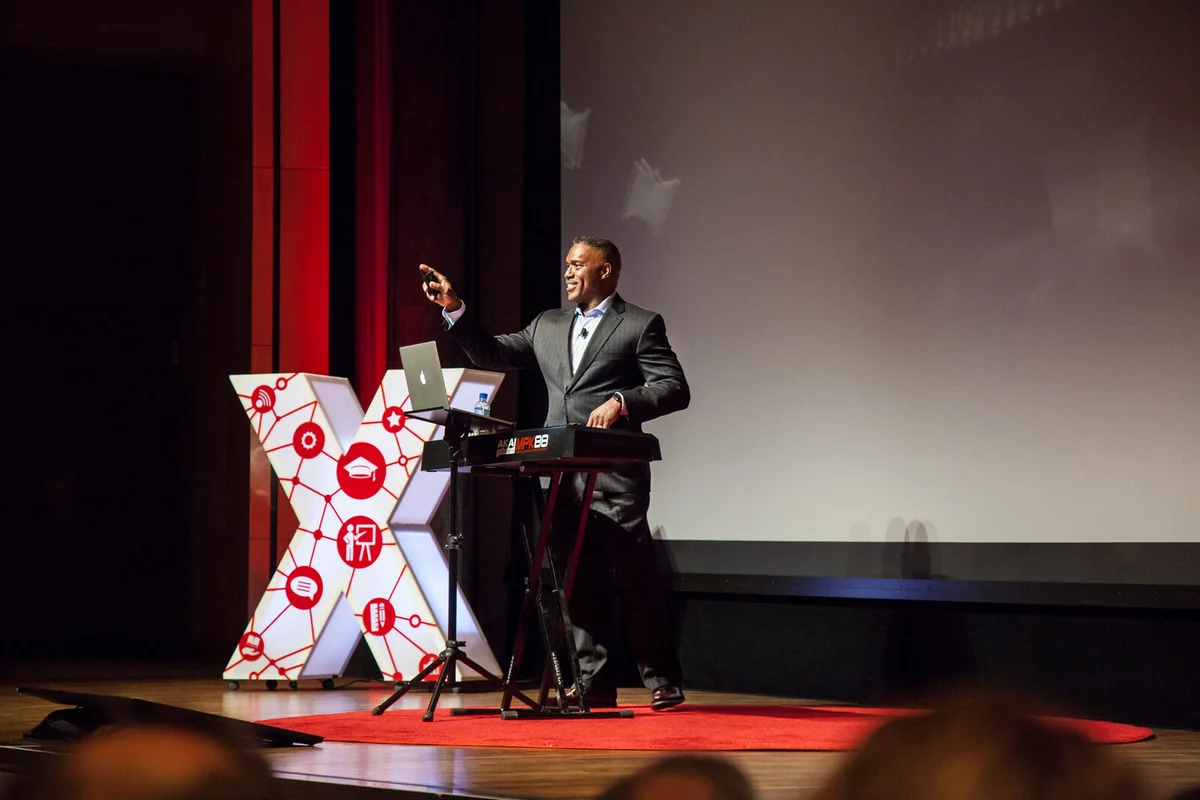
Servant leadership is not softness.
It is the decision to go first — into the hard meeting, into the unfamiliar technology, into the conversation nobody else wants to have — so the people behind you do not have to go alone.
That is what I did with technology in a school district when it was risky and unpopular. It is what I did on a stage in 1984 when a Black rock band on MTV was not a thing that existed yet.
It is what I am doing now, in rooms full of leaders who are being told they are behind and quietly wondering whether anybody actually knows the way.
Somebody has to go first. That is the whole job.
People lead. Technology serves. Leadership decides.
Bring me the thing you cannot answer.
A strategy session is thirty minutes. There is no pitch in it — just the question you have been carrying, and someone who has carried it before.